
With more than 1.2 million Indians stuck in green card backlogs, investor-driven EB-5 programme sees rising interest as a secure route for migration to the US.

India has decided to submit a dossier at the upcoming Financial Action Task Force (FATF) meeting, calling for Pakistan to be placed back on the grey list of the global money laundering and terrorist financing watchdog.

Zohram Kwame Mamdani would be the city's first Muslim and Indian American mayor if elected New York mayor this November.

With general government debt now approaching three-quarters of GDP, and only incremental reform efforts visible, Pakistan risks prolonging its economic stagnation unless fundamental governance, regulatory, and industrial overhauls are undertaken.

The stock and bond markets told Trump firmly that any idea of isolating China would lead to harming the US economy and this forced Trump to backtrack, points out Aakar Patel.

Markets closed in the red on domestic worries.

The declared incomes of registered unrecognised political parties witnessed a 223 per cent spike in 2022-23 and more than 73 per cent of these parties failed to publicly disclose their financial records, according to poll rights body the Association for Democratic Reforms (ADR).
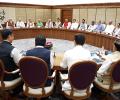
'The expeditious enactment of labour codes and strategic measures to bridge the skills jobs gap are critical.'

The government will introduce a new Income Tax bill next week to take forward the "trust first, scrutinise later" concept, Finance Minister Nirmala Sitharaman said on Saturday. In another major reform move, the minister announced that the Foreign Direct Investment (FDI) in the insurance sector will be increased to 100 per cent from 74 per cent.
The revised guidelines are aimed at curbing discretionary practices by field officers, especially the tendency to seek documents not mandated under the law.

The 31st meeting of the Goods and Services Tax (GST) Council, held in December 2018, deferred a decision to reduce the GST rate for cement from 28 per cent to 18 per cent. This was despite recognising that cement - along with automobile parts - remained among the few mass-consumption items still taxed at the highest slab, which was originally meant for luxury and sin goods.
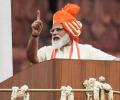
Prime Minister Narendra Modi on Wednesday underscored tax reforms of the past six years to say India has moved from tax terrorism to tax transparency. Speaking at the inauguration of an office-cum-residential complex of the Income Tax Appellate Tribunal at Cuttack, Modi highlighted the reduction in the corporate tax rate, simplified rate structure for individual taxpayers, faceless appeals and quick refunds.

The time is ideal for a 'Dream Budget' akin to the 1991 reforms that sparked high growth and unlocked significant gains in productivity, points out Rajeswari Sengupta.

The International Monetary Fund (IMF) has slapped 11 new conditions on Pakistan for the release of the next tranche of its bailout programme and warned that tensions with India could heighten risks to the scheme's fiscal, external, and reform goals, according to a media report on Sunday.

From the 30-share blue-chip pack, Zomato surged over 7 per cent. Maruti, ITC Hotels, ITC, Mahindra & Mahindra, Asian Paints, Titan and IndusInd Bank were among the biggest gainers. Power Grid, Larsen & Toubro, NTPC, UltraTech Cement, HCL Tech, Tech Mahindra, Infosys and Adani Ports were among the laggards.

Leading passenger vehicle maker Maruti Suzuki on Saturday reported marginal growth while Hyundai and Tata Motors posted a decline in their sales in February as a slowdown in the market continued with demand remaining muted. On the other hand, Mahindra & Mahindra and Toyota Kirloskar Motor posted double-digit growth riding on their SUV and MPV models.

The disbursement of the second tranche comes on a day when the International Monetary Fund is holding virtual discussions on Pakistan's upcoming budget, as the visit of its mission to Islamabad was delayed due to security concerns in the region.

Passenger vehicle dispatches in India from factories to dealers rose to record levels at over 43 lakh units in FY25, with utility vehicles accounting for 65 per cent of the total sales in the segment, industry body SIAM said on Tuesday. Passenger vehicle (PV) dispatches rose to 43,01,848 units in the last fiscal year, marking a 2 per cent increase compared to 42,18,750 units in FY 2023-24.
'Volumes in F&O trading had gone up rapidly and, in a way, the increase in STT on F&O will protect investor interest.'
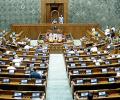
Bharatiya Janata Party on Thursday issued a three-line whip to all of its Lok Sabha MPs asking them to be present in the House for the passing of the Union Budget 2025-26.

The upcoming delimitation exercise should reflect the social realities uncovered by the census, ensuring proportional political representation for marginalised groups, it read.

'Spend, but create assets, spend but make sure that people benefit from it.' 'This has been a beautiful guiding principle. And I think as a finance minister I owe so much to the prime minister for keeping this path clear before us.'

Assuming we still have a Modi-led majority government after May 2024, there is no guarantee that reforms will move at anything more than a snail's pace, though we must be thankful even for that, notes R Jagannathan.

High-value insurance policies experienced muted growth in the first six months of the current financial year after the Centre decided to tax such products in this year's Budget. Simultaneously, there has been a marked improvement in the growth of policies with premiums of 'less than Rs 5 lakh', mainly originating from smaller cities. During this year's Budget, Finance Minister Nirmala Sitharaman proposed that insurance policies (excluding unit linked insurance plans or ULIPs) with an aggregate premium exceeding Rs 5 lakh, and the maturity amount, would not be exempt from tax.

The Union government is projected to share about 32 per cent of central taxes with states during the financial year 2024-25 against the 15th Finance Commission's recommendation of 41 per cent. The Revised Estimates (RE) for FY24, too, show a similar share of states in the central taxes at 32 per cent. In absolute terms, however, there has been an increase in the amount devolved to states compared to the Budget Estimates (BE) for FY24 at Rs 11 trillion.

India's Venture Capital (VC) ecosystem exhibited robust growth in 2024, with funding surging 43 per cent year-on-year to $13.7 billion, according to a report. This recovery was fuelled by a 45 per cent rise in deal activity, with 1,270 transactions recorded, reinforcing India's position as the second largest market for venture capital and growth funding in the Asia-Pacific region, the report by Bain & Company and IVCA said.
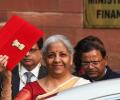
'... that it once again shies away from renewing its commitment to strategic divestment,' points out A K Bhattacharya.

While the capital spending is being maintained at 3.1 per cent of the GDP, a little more would have boosted economic growth even further, suggests Rajiv Memani.

Till such time that a new governance framework comes into being, the progress of reforms in health, education, land, labour, electricity and agriculture could remain fraught with problems, agitations and delays, observes A K Bhattacharya.
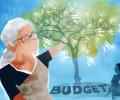
Finance Minister Nirmala Sitharaman will present the Union Budget for 2023-24 in Parliament on February 1. The Budget is a statement of the government's estimated receipts and expenditures for a fiscal year (April 1 to March 31). It's divided into Revenue and Capital Budget. The Revenue Budget includes the government's revenue receipts and expenditures while the Capital Budget includes its capital receipts and payments.
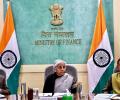
The Budget assumes significance as it comes on the back of lower-than-expected growth numbers during the second quarter and geopolitical uncertainty.
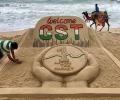
Six years after the rollout of the biggest indirect tax reform in India, Goods and Services Tax (GST) revenue of Rs 1.5 lakh crore every month has become a new normal and tax officers are focusing on dealing with fraudsters who are adopting newer modus operandi to game the system, causing loss to the exchequer. To apprehend black sheep, who operate as syndicates and create fake entities on the basis of forged documents to claim input tax credit (ITC), tax officers have started using data analytics, artifical intelligence and machine learning aiming to curb evasion, which was over Rs 3 lakh crore since inception of GST. It was over Rs 1 lakh crore in 2022-23. Thinktank Global Trade Research Initiative (GTRI) said the most critical pending GST reform is upgradation of GST Network to prevent fake supplies and fraudulent claims of Input Tax Credit (ITC).

'But this Budget alone will not fix what ails the Indian economy.'

From the 30-share blue-chip pack, ITC Hotels, IndusInd Bank, Mahindra & Mahindra, Sun Pharma, UltraTech Cement and NTPC were among the biggest gainers. Titan, Kotak Mahindra Bank, Nestle, Asian Paints, HCL Tech and ICICI Bank were among the laggards.


Industry body CII on Thursday made a case for pushing reforms in sectors like land, labour, and agriculture by the Modi 3.0 government to accelerate economic growth, which is estimated to be around 8 per cent in the current financial year. CII president Sanjiv Puri said a lot of policy interventions in the past have put the economy on "a much stronger wicket". "The growth rate is poised to touch 8 per cent during the current year, marking the fourth consecutive year of above 7 per cent + growth.

RBI's interest rate decision, quarterly earnings and global cues would be the major driving factors for equity markets this week, analysts said adding that the impact of the Union Budget could linger on this week. Trading activity of foreign investors will also be a key driver for the markets, experts noted. "US and India's manufacturing PMI for January to be released on Monday, will be the key macro data to watch out for.
Goods and Services Tax collections jumped 10.4 per cent to over Rs 1.72 lakh crore in January, reflecting buoyant economic activity and setting the stage for the next phase of GST reforms. This is the second-highest monthly collection ever and marks the third month in this financial year with a collection of Rs 1.70 lakh crore or more, a finance ministry statement said on Wednesday.
Vijay Kelkar, who headed the committee on tax reforms, on Tuesday warned that higher economic growth and foreign direct investment flow could not be achieved without hard fiscal reforms.
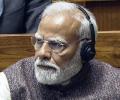
Prime Minister Narendra Modi has lauded the Union Budget as a "people's budget" that fulfills the dreams of every Indian and said that it is a "force-multiplier" that will boost consumption, investment and growth. He highlighted a host of measures for different sectors, including welfare initiatives for gig workers, tax relief for the middle class, and support for the manufacturing sector.
 © 2026 Rediff.com - Advertise with us - Disclaimer - Privacy Policy - Sitemap - Feedback - About us - Terms of use - Grievances